
Room to Learn: Mapping India’s Classroom Infrastructure Gap
Room to Learn: Mapping India’s Classroom Infrastructure Gap
Published on :- November 20th, 2026
An analysis of UDISE+ 2025-26 data on classroom adequacy, student density and infrastructure disparities across India.
Introduction: Beyond the number of schools
India has made progress in expanding school access and strengthening foundational learning. Yet learning outcomes fall sharply as grades progress; the national average mathematics scores are 60% in Class 3 and 37% in Class 9, according to the PARAKH Rashtriya Sarvekshan 2024. Meanwhile only 48.8% of rural Class 5 children can read a Class 2 text (ASER 2024). Beyond learning levels, a more basic question lies underneath: do India’s schools have adequate physical space to support every child’s learning?A school building alone does not guarantee a conducive learning environment. Sufficient usable classrooms, manageable student density and functional infrastructure are essential to supporting effective teaching, individual attention and grade-specific instruction. When usable classrooms are insufficient relative to the grades offered, schools need to adopt shared-space arrangements, staggered timetables or other scheduling adjustments. Such constraints make grade-specific instruction more difficult to organise, particularly for foundational literacy and numeracy.
This analysis of UDISE+ 2025-26 data, covering 14.61 lakh schools and 23.23 crore students, examines school infrastructure through the lens of usable classroom adequacy. It covers government schools (69% of all schools and 50% of student enrolment), private schools (23% of schools and 38% of enrolment), and government-aided institutions (5% of schools and 10% of enrolment) and Others (3% of schools and 2% of enrolment).
How we measure classroom adequacy
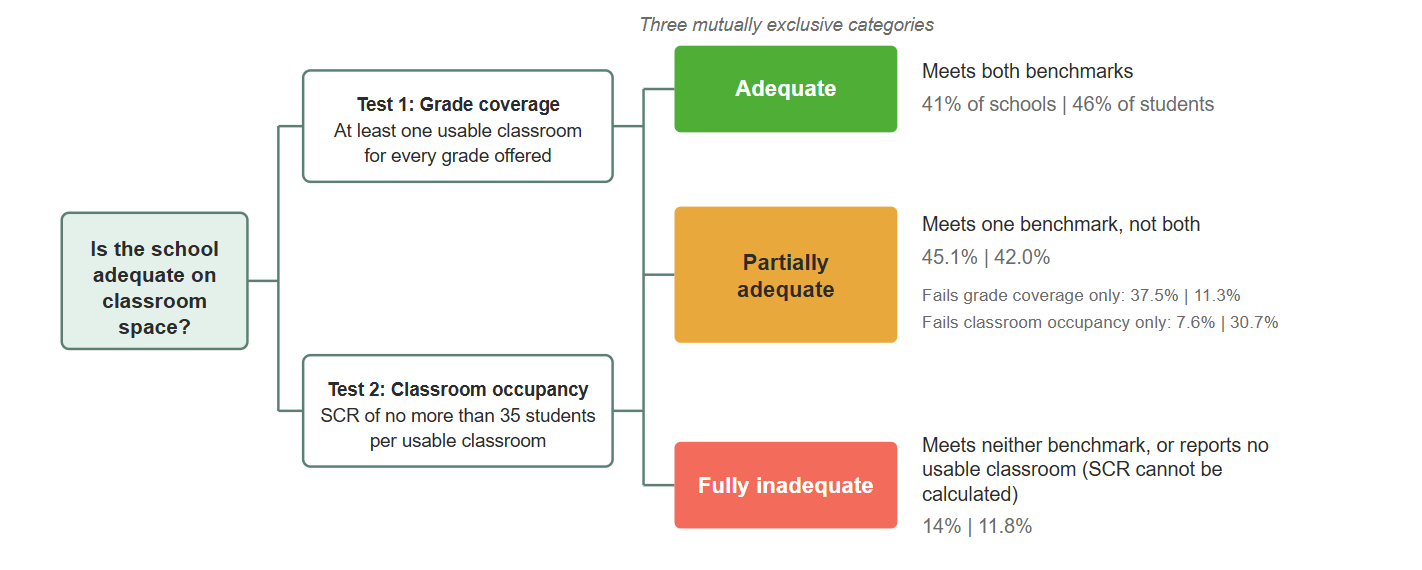
This analysis defines usable classrooms as those reported to be in good condition or requiring only minor repairs. Classrooms needing major repairs are not counted as usable. Adequacy of a school is assessed against two benchmarks:- Grade coverage: At least one usable classroom for every grade offered by each school.
- Classroom occupancy: A student-to-classroom ratio (SCR) of no more than 35 students per usable classroom.
The analysis adopts a threshold of 35 students per classroom to assess classroom adequacy across Classes I–XII. This benchmark is informed by the RTE Act, 2009, which prescribes a pupil-teacher ratio of 35:1 at the upper-primary level (Classes VI–VIII) and requires at least one classroom per teacher. Assuming one classroom per teacher, this provides an indicative basis for adopting 35 students per classroom as an analytical benchmark. The threshold is extended across Classes I–XII for consistency in the analysis and is not interpreted as a statutory student-classroom norm.
Based on these benchmarks, schools across India are categorised as:- Adequate: Schools that meet both grade coverage and classroom occupancy benchmarks.
- Partially adequate: Schools meeting one benchmark but not both.
- Fully inadequate: Schools that do not meet either of the benchmarks include those that genuinely fall short and those for which the Student-Classroom Ratio (SCR) cannot be calculated due to the absence of reported data on usable classrooms.
EXHIBIT 1
Two tests sort every school into one of three mutually exclusive segments
Classroom adequacy framework, with share of schools and share of students in each segment
Source: UDISE+ 2025-26
Four limitations apply. First, the assumption of one classroom per grade does not account for flexible timetabling and can overestimate classroom shortages in schools where classrooms are shared across grades. Second, reported classroom availability does not necessarily reflect actual usability, as physical conditions may limit their effective use. Third, school-wide student-classroom ratios can mask grade-specific overcrowding, where the same classrooms are used by different groups of students at different times. Finally, the assessment captures physical classroom capacity rather than overall school readiness or learning outcomes.
National landscape: 54% of enrolled students attend inadequate schools
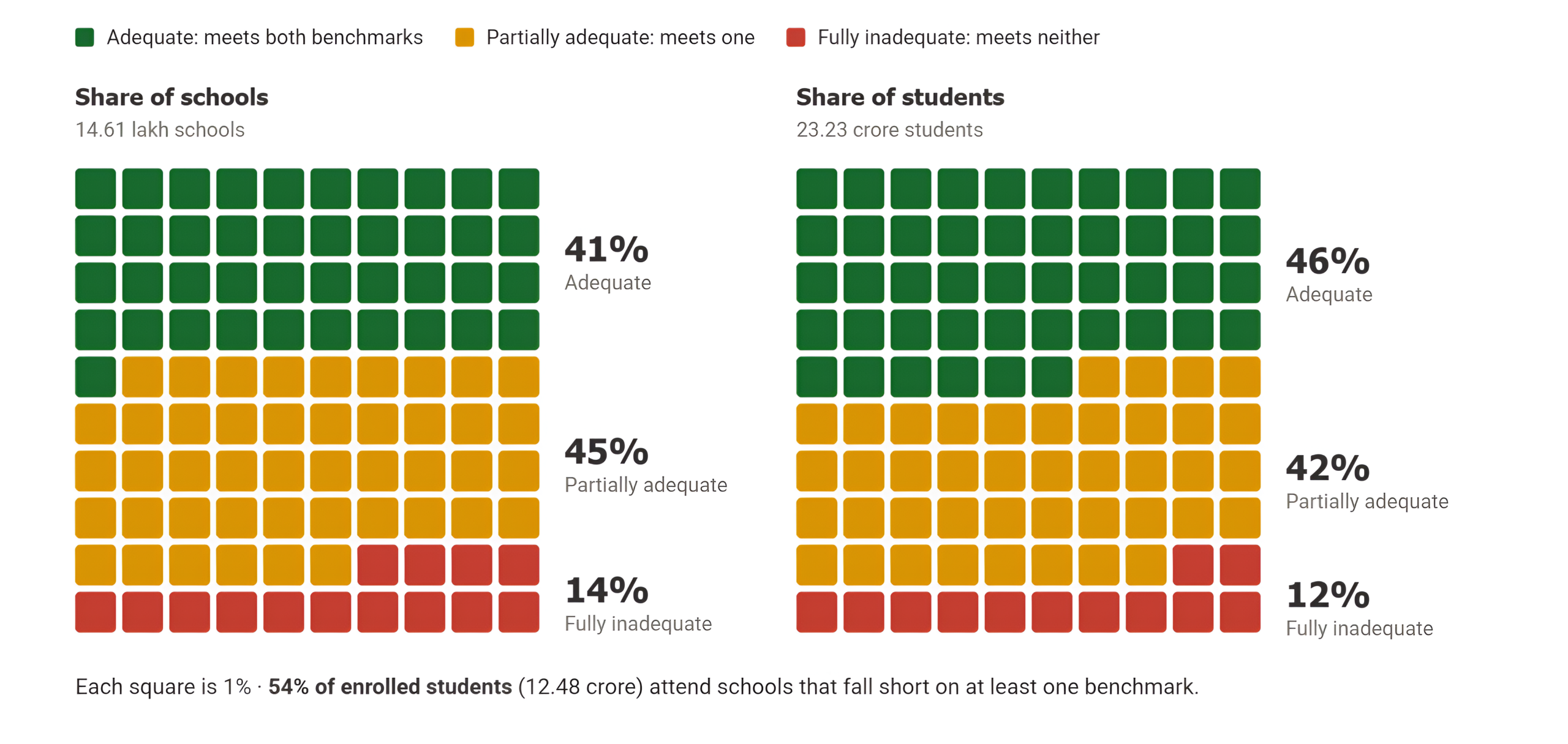
Only 41% of schools meet both classroom adequacy benchmarks, accounting for 10.74 crore of total student enrolment. 45% are partially adequate, serving 9.75 crore students, while another 14% are fully inadequate, affecting approximately 2.73 crore students.These findings point to two distinct priorities: targeted improvements in partially adequate schools and more substantial infrastructure investments in schools facing severe classroom deficits.
EXHIBIT 2
41% of Indian schools meet adequacy benchmarks
Share of schools and share of students by classroom adequacy category
Source: UDISE+ 2025-26. Shares may not sum to 100% due to rounding.
45% of schools only meet half of the adequacy benchmarks
Among the 6.6 lakh schools classified as having partially adequate classrooms, two distinct challenges emerge: insufficient classrooms to cover all grades offered and overcrowding due to high SCR.
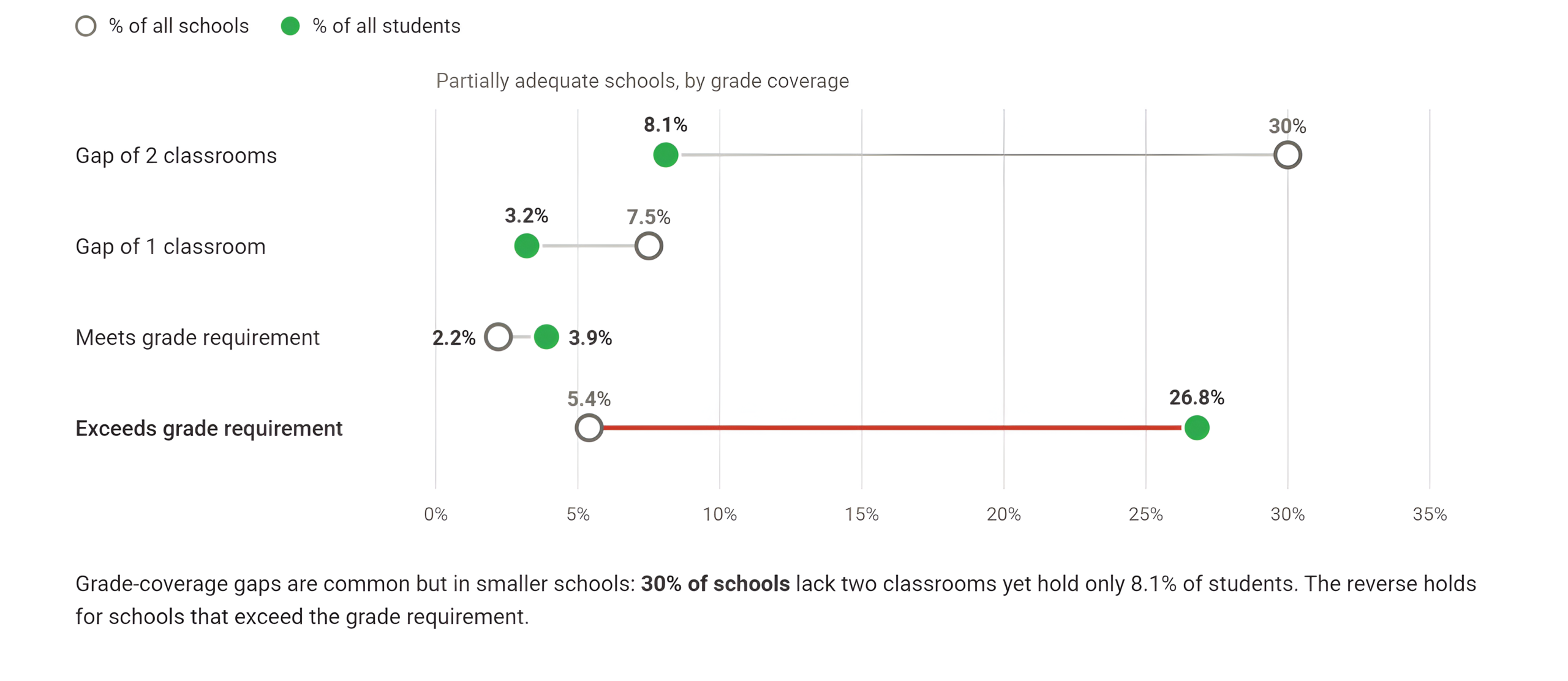
Of all schools nationally, 37.5% are partially adequate because they have fewer usable classrooms than the number of grades offered. These schools account for around 11.3% of total student enrolment, suggesting that the shortfall in classroom availability, while widespread, affects a relatively smaller proportion of students.
EXHIBIT 3
37.5% of schools have fewer usable classrooms than grades offered.
Share of schools and students in partially adequate schools by grade coverage
Source: UDISE+ 2025-26.
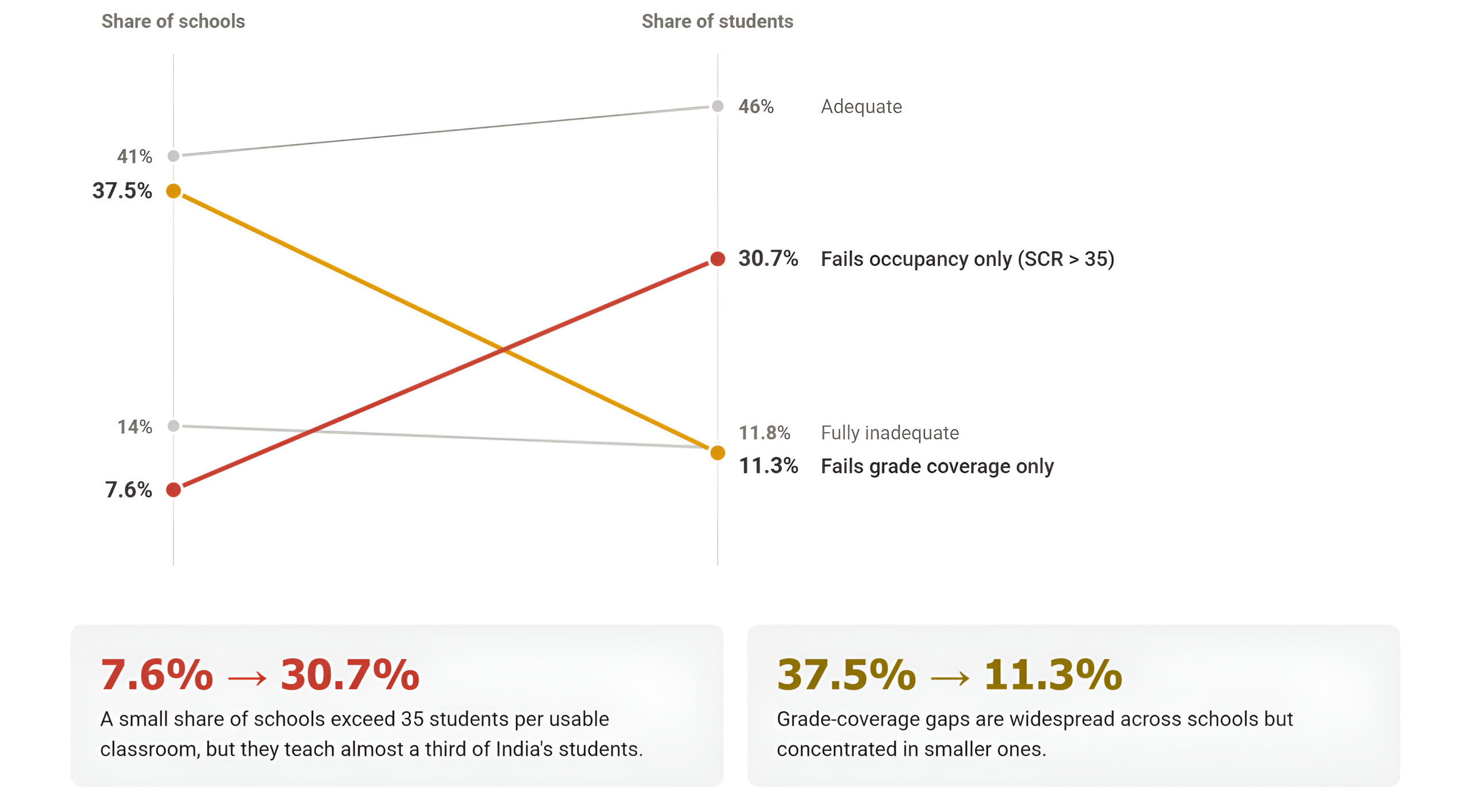
In contrast, 7.6% of schools are partially adequate because of high SCR, despite meeting the grade coverage benchmark. These schools account for 30.7% of total enrolment, indicating that classroom congestion is concentrated in schools serving larger student populations.
EXHIBIT 4
30.7% of India’s students learn in congested classrooms
How the 2 partially adequate categories shift between share of schools and students
Source: UDISE+ 2025-26.
Addressing both requires not just expanding classroom infrastructure but ensuring its equitable distribution in line with local enrolment levels. This is particularly important in geographically dispersed or underserved areas, where students have limited access to alternative schools. Infrastructure planning must therefore account for local enrolment pressures rather than assume that students can simply shift to less crowded institutions.
14% of schools face severe classroom infrastructure deficits
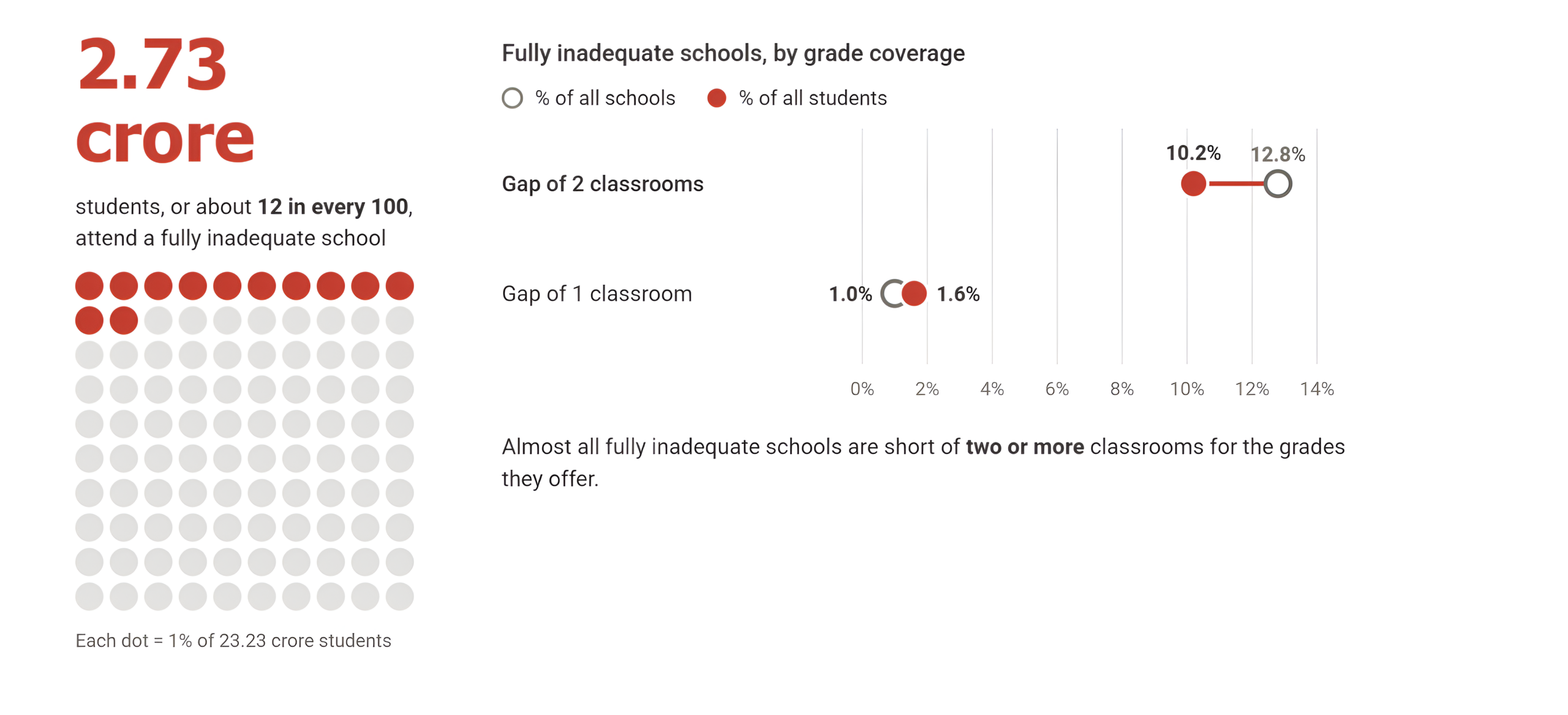
About 2.03 lakh schools (14%) are fully inadequate. The classroom gap is more pronounced among nearly 1.25 lakh schools classified as fully inadequate, which face a combination of insufficient classrooms and high SCR. Gaps in these schools affect 11.8% of student enrolments.EXHIBIT 5
Complete inadequacy affects 2.7 crore students
Students in fully inadequate schools and those by classroom gap
Source: UDISE+ 2025-26.
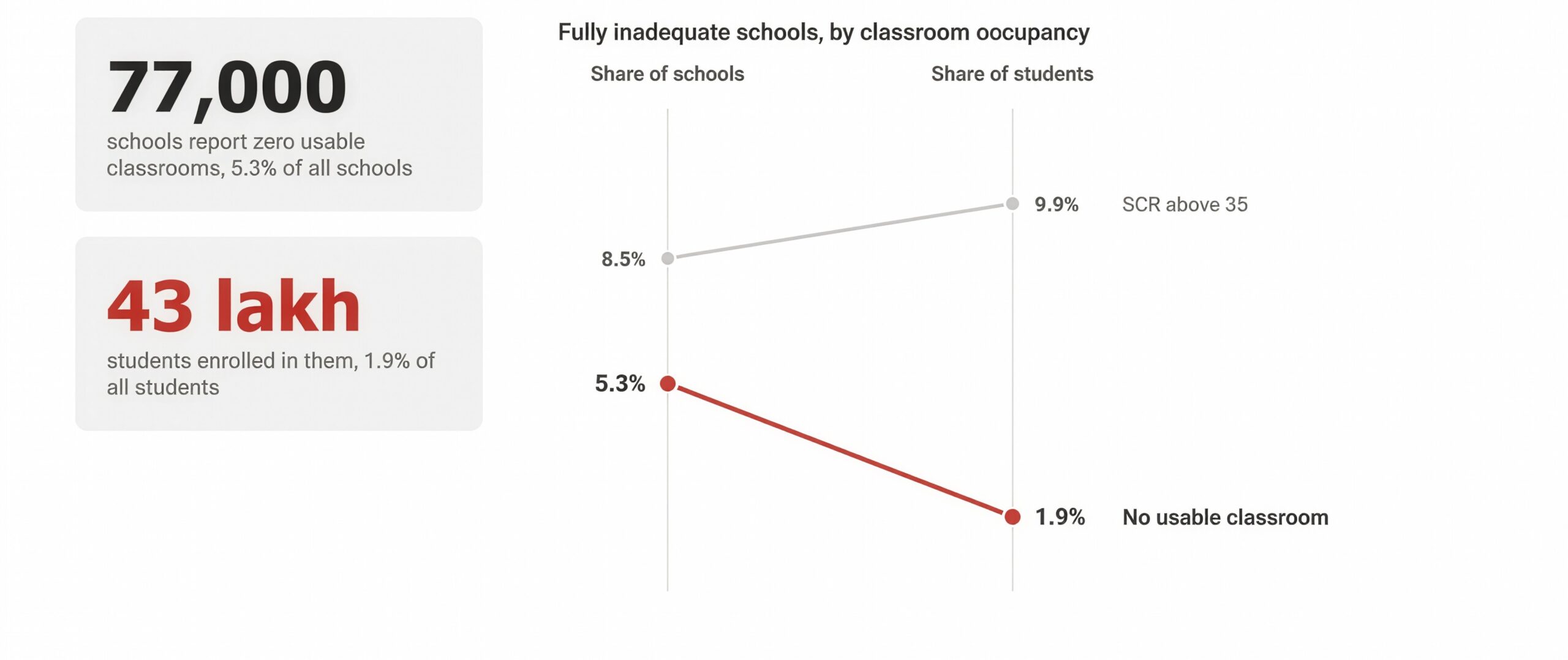
Around 78,000 fully inadequate schools, serving 43 lakh students, report zero usable classrooms. Since these schools report no usable classrooms, a student-to-classroom ratio cannot be calculated. The reported absence of usable classrooms also warrants further validation to establish whether these schools genuinely lack functional classrooms or whether the figures reflect reporting gaps or inconsistencies. Schools that need incremental infrastructure improvements, and those where the availability of usable classrooms is itself a critical concern, require different responses.
EXHIBIT 6
43 lakh students go to schools with no usable classrooms
Fully inadequate schools split by classroom occupancy
Source: UDISE+ 2025-26.
Government schools drive India’s classroom infrastructure deficit
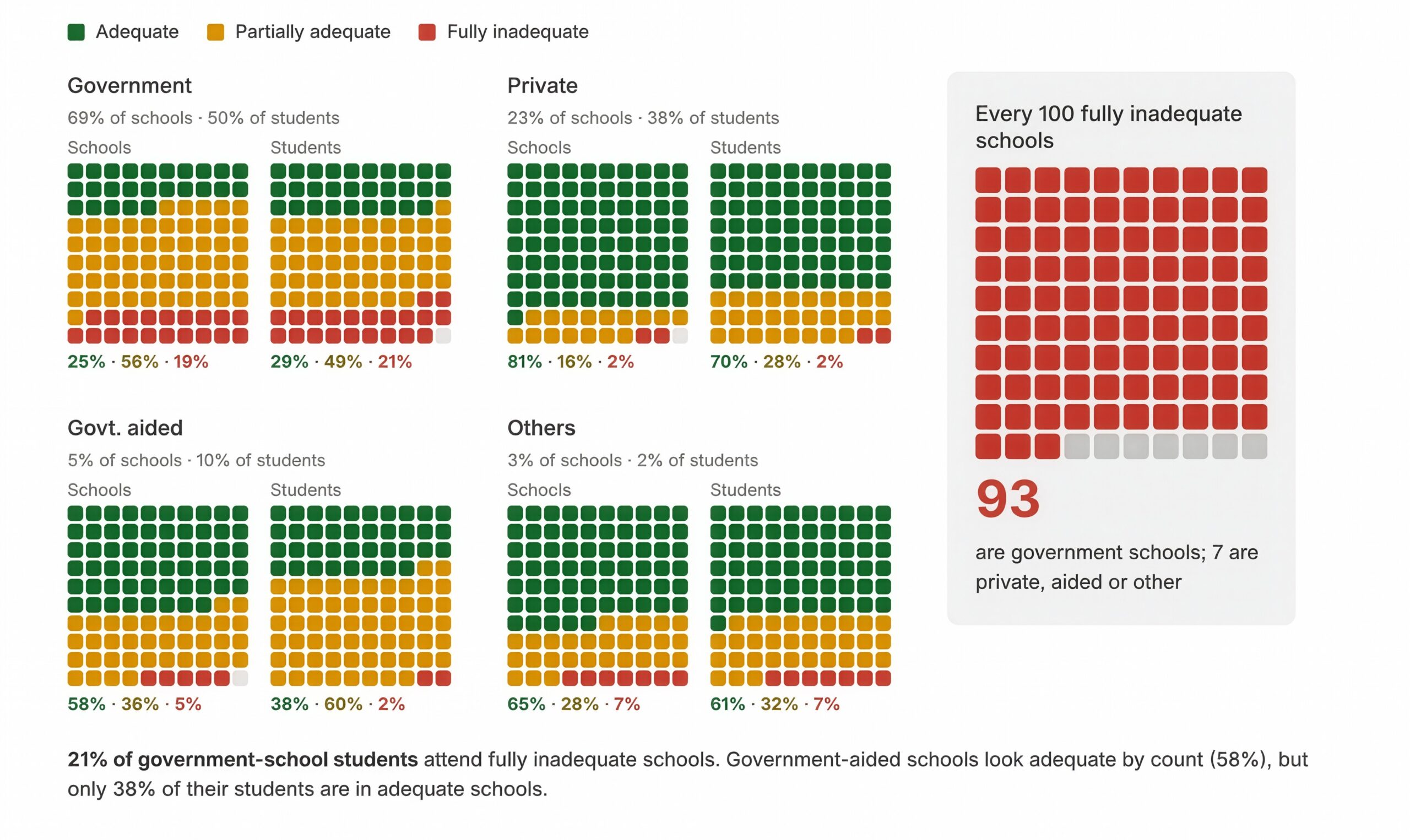
Government schools, which serve half of all Indian students, have the largest infrastructural gaps. 19% of government schools have fully inadequate classrooms, which affects 21% of government school students. These account for roughly 93% of all fully inadequate schools nationwide, pointing to an urgent need.Private schools demonstrate substantially higher classroom adequacy. 81% of private schools meet the classroom adequacy criteria, and 70% of students enrolled in private schools attend these schools which are adequately equipped. 7,000 private schools are classified as inadequate, and serve 16.3 lakh students.
EXHIBIT 7
93% of all fully inadequate schools are government schools
Classroom adequacy by school management
Source: UDISE+ 2025-26.
Classroom adequacy varies sharply across states
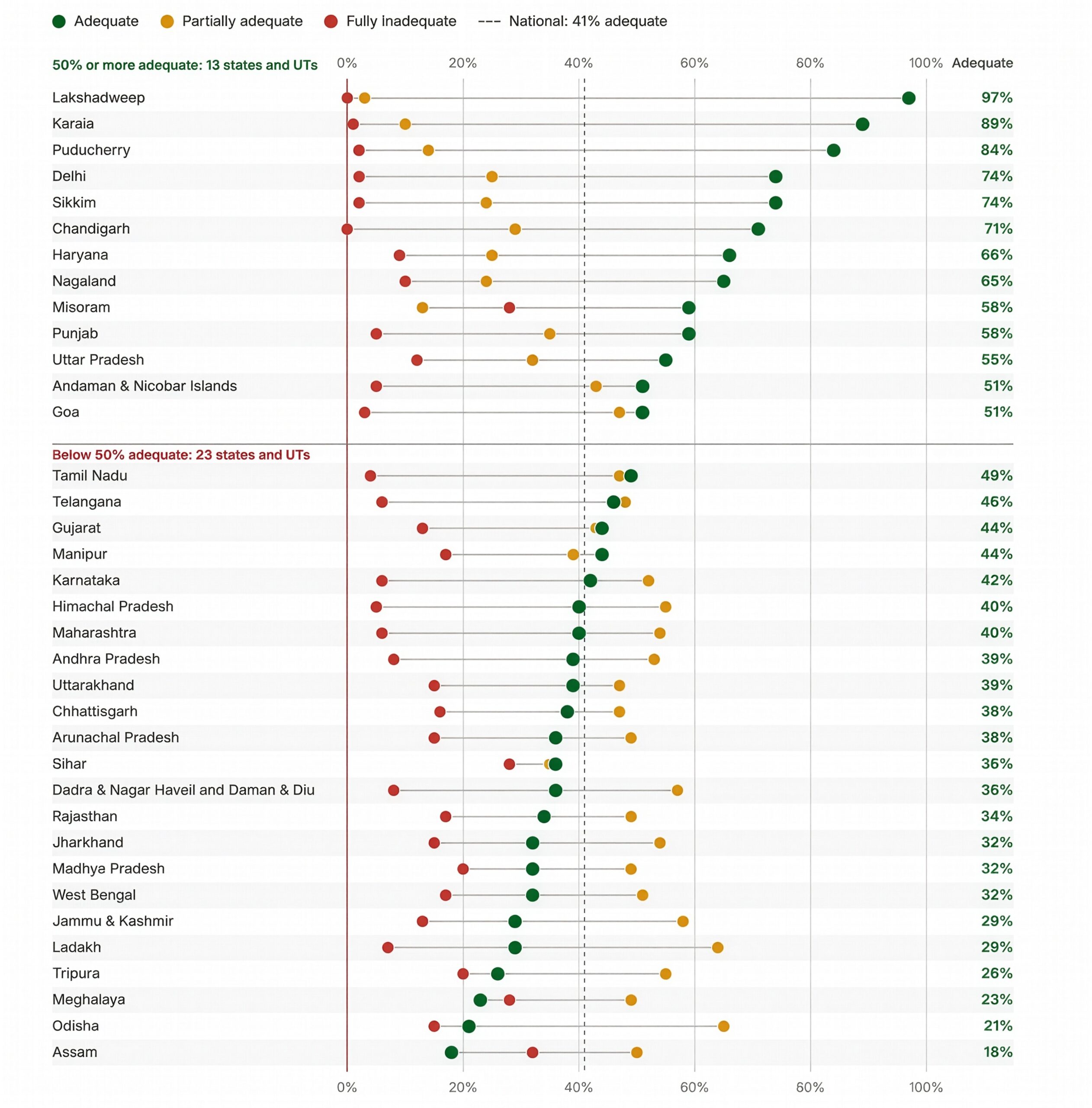
National averages mask considerable variation in classroom adequacy across states and union territories. The proportion of fully adequate schools ranges from 97% in Lakshadweep and 89% in Kerala, 74% in Sikkim and Delhi to just 18% in Assam and 21% in Odisha. Assam, Mizoram, Meghalaya and Bihar face some of the most severe infrastructure deficits, with 28% to 32% of schools classified as fully inadequate.Partial adequacy is widespread in several states and union territories. In 12 states and union territories, at least half of all schools are partially adequate, indicating gaps in classroom availability for grade separation and/or student-to-classroom ratios. Odisha (65%), Ladakh (64%) and Jammu and Kashmir (58%) have particularly high concentrations of Partially adequate schools, presenting opportunities for targeted upgrades.
The variation across states reinforces the need for geographically responsive interventions. States with a high share of fully inadequate schools (e.g. Assam, Meghalaya, Bihar, Mizoram) require more intensive investments, while those with a large concentration of partially adequate schools (such as Odisha, Ladakh and J&K) benefit from interventions addressing specific classroom capacity constraints.
EXHIBIT 8
Less than 50% schools are adequate in 23 states and UTs
Share of schools by classroom adequacy category, states and UTs ranked by adequate share
Source: UDISE+ 2025-26.
Strengthening classroom infrastructure through targeted action
India's school infrastructure challenge extends past the availability of school buildings, to ensuring that every school has sufficient, functional and adequately equipped classrooms to support the grades it offers. With 59% of schools falling short of the full classroom adequacy benchmarks, targeted investments are needed to address both classroom shortages and overcrowding, particularly in government schools and regions facing greater infrastructure deficits.These constraints are not uniform. Some schools require additional usable classrooms to ensure grade-wise coverage, while others need greater classroom capacity to accommodate their student populations. Furniture shortages add another dimension to these classroom gaps (see box below). Addressing these challenges requires moving beyond uniform infrastructure investments towards interventions that respond to the specific constraints facing individual schools.
While state-level findings highlight broad regional disparities, they may conceal substantial variations across districts and sub-districts. A data-driven and hyperlocal approach is therefore required to identify schools with the most pressing infrastructure needs and prioritise investments accordingly.
Improving the physical conditions in which children learn requires moving beyond school counts to assess the adequacy, usability and equitable distribution of learning spaces. By aligning infrastructure investments with local demand and the nature and severity of school-level deficits, India can move towards ensuring that every child has access to a functional and conducive classroom environment.
Furniture availability also affects classroom functionality
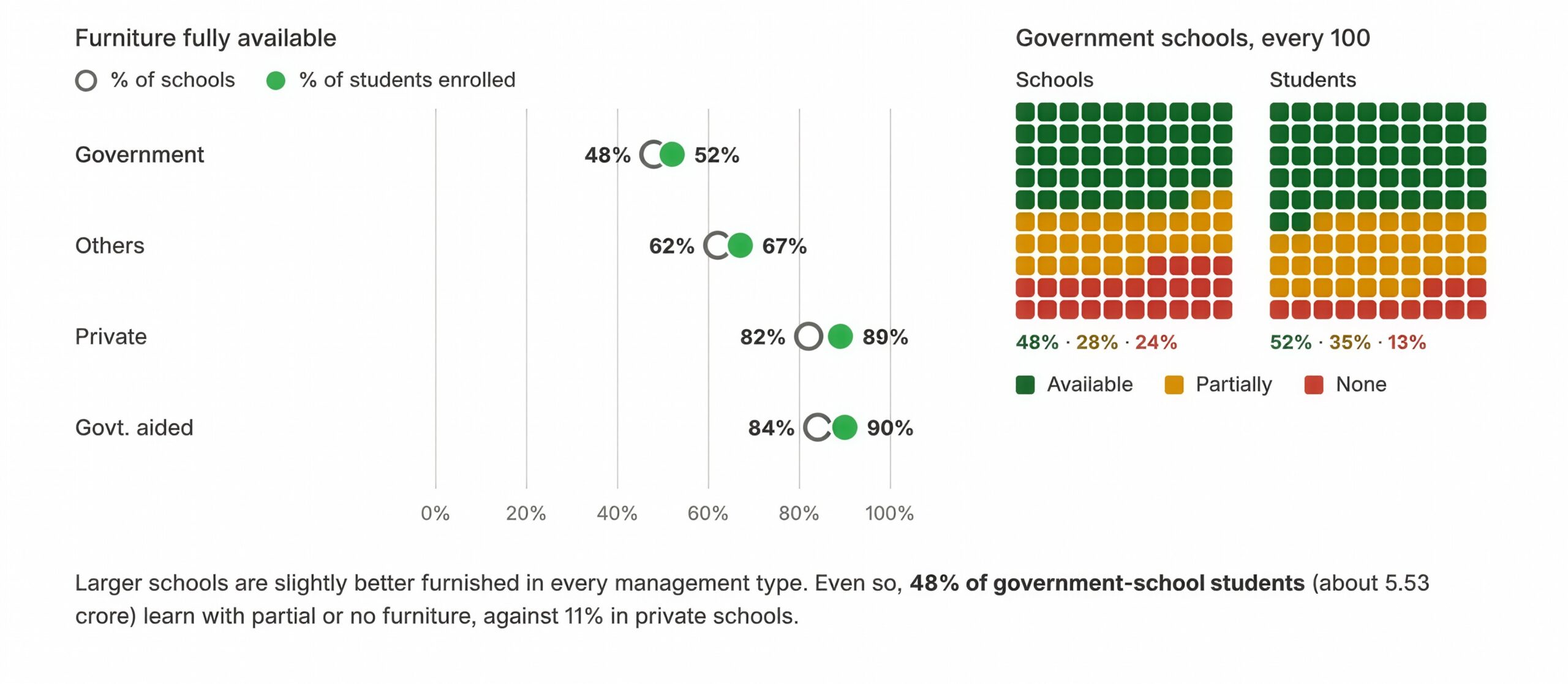
Beyond classroom availability, the analysis also examines furniture provision as a complementary indicator of the functionality of school learning environments. Unlike classroom adequacy, furniture availability is assessed separately using UDISE+ school-level reporting categories, which categorises it as available, partially available or unavailable. The findings reveal stark gaps, particularly in government schools.Only 48% of government schools report furniture as fully available, compared with 82% of private schools and 84% of government-aided schools. More than half (52%) of government schools report partial or no furniture provision, with 24% reporting no furniture at all. While these figures indicate substantial gaps in school furniture provision, the unusually high proportion reporting zero furniture also warrants further validation to rule out possible reporting inconsistencies. These gaps affect approximately 5.53 crore students enrolled in government schools with partial or no furniture. In comparison, private schools report better provision, covering 89.3% of student enrolment.This highlights the need for infrastructure interventions to also include classroom construction and repairs. Addressing furniture shortages, particularly in government schools,ensures that physical learning spaces are functional, adequately equipped and conducive to classroom instruction.
EXHIBIT 9
Government schools face the widest furniture gaps
Share of schools and students enrolled where furniture is reported as available
Source: UDISE+ 2025-26.